


NetSuite Part Number Translation: Why One Sales Order Requires 3 Spreadsheets
NetSuite Part Number Translation: Why One Sales Order Requires 3 Spreadsheets https://echovera.ca/wp-content/themes/corpus/images/empty/thumbnail.jpg 150 150 Tim Robertson https://secure.gravatar.com/avatar/b0b77ea14349870d9dc2ba8ce2a0947073217d2f742890353bfc00417e8e4b8a?s=96&d=mm&r=g“We spend more time translating part numbers than actually entering orders into NetSuite.”
One sales order arrives. Three different part numbering systems. Zero of them match your NetSuite item numbers.
Here’s what that actually looks like:
Line 1: Customer internal code “A-2847-B” Line 2: Vendor catalog number “VN-48392” Line 3: Retailer SKU “RTL-9483-02”. All three refer to items in your NetSuite system. None match your NetSuite item numbers.
The order sits while someone plays detective. If you’re managing NetSuite order entry for a distribution, manufacturing, or retail operation, you’ve lived this. The constant cross-referencing. The spreadsheet lookups. The emails asking “What item is this code referring to?”
This isn’t a data problem. It’s a workflow problem. And it’s costing you more time than you think.
The Real Cost of Manual Part Number Translation
Let’s walk through what actually happens when that three-line order arrives.
The Current Process (Step by Painful Step)
Line 1 arrives: Customer code “A-2847-B”
Your finance admin opens the spreadsheet of customer codes. Scrolls down. Looks for “A-2847-B.” No match found. They email the customer: “What item is A-2847-B?” Order sits. Waiting. Customer responds the next day: “That’s your product PROD-2156.” Translation recorded in the spreadsheet. One line down.
Line 2: Vendor catalog number “VN-48392”
Opens the vendor code reference sheet. Looks up “VN-48392.” Finds the match: Your NetSuite item “PROD-1847.” Translation recorded. Second line down.
Line 3: Retailer SKU “RTL-9483-02”
Checks the retailer mapping table. Code matches, but there’s a problem: pack size doesn’t align. The retailer orders by case (12 units). Your NetSuite system tracks individual units. Manual calculation required. 12 cases × 12 units = 144 units. Enters “144” for item “PROD-3489.” Three lines. Three lookups. One email delay. One unit conversion. Total time: 15 minutes for three lines. And that’s if you’re lucky.
Multiply That Across Real Order Volume
Now take that three-line order and multiply it:
- 40-line purchase orders
- 300-line bulk orders
- 15 orders per day
- Multiple people doing the same lookups
The friction compounds fast:
Time friction: – Orders queue while waiting for translation responses – Each lookup interrupts the workflow > Context switching between spreadsheets kills productivity > Email delays add hours or days to order processing
Error friction: – Missing translations require back-and-forth communication > Unit of measure mismatches create fulfillment errors – Outdated reference sheets lead to wrong item mappings > Manual conversions introduce calculation mistakes
Maintenance friction: – Cross-reference sheets need constant updating > New vendor codes require manual addition > Customer numbering changes break existing mappings > No single source of truth—multiple spreadsheets drift out of sync
One operations admin described it this way: “We spend more time translating part numbers than actually entering orders into NetSuite.”
That’s the bottleneck. Not data entry. Translation.
Why This Problem Exists (And Why It’s So Common)
Part number translation chaos isn’t a sign of poor planning. It’s a natural consequence of growth.
Your Business Scales, Your Numbering Systems Multiply
When you start with one or two customers, you can keep their codes in your head. Maybe a simple spreadsheet works fine.
Then you add: – A second customer with their own internal codes > A third-party retailer with their SKU system > Multiple vendors, each with their catalog numbers > Distributors who repackage and re-code your products > International partners with different numbering conventions
Suddenly you’re managing five, ten, fifteen different part numbering systems—none of which talk to each other.
NetSuite Isn’t Built for Cross-System Translation
NetSuite is excellent at managing your internal item master. But it doesn’t natively handle:
- Real-time translation of external codes to internal items
- Multi-system vendor code mapping
- Customer-specific part number references
- Automated unit of measure conversions between systems
- Dynamic lookup tables that update without manual entry
You can build custom fields. You can create saved searches. You can even script some solutions. But most operations teams don’t have the development bandwidth for that. So they default to what’s available: spreadsheets and manual lookups.
The “We’ll Build Better Reference Sheets” Trap
Here’s the common response: “We just need better reference sheets.” So teams invest in: – More detailed spreadsheets > Shared Google Sheets with lookup formulas > Master mapping documents > Code translation guides
The reference data improves. The process doesn’t. Because the constraint isn’t lack of reference data. The constraint is that translation happens manually, order by order, line by line. No matter how good your spreadsheet is, someone still has to: 1. Open it 2. Find the right tab 3. Search for the code 4. Copy the translation 5. Switch back to NetSuite 6. Paste it in 7. Repeat for the next line
That’s workflow friction that better data can’t fix.
What Automated Part Number Translation Actually Looks Like
When intake automation handles part number translation, the sequence changes completely.
The Automated Process
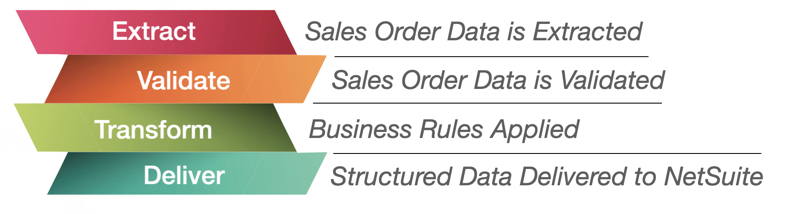
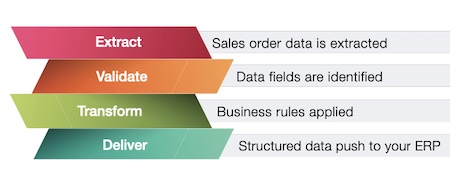
PO arrives → System translates all part numbers → Flags unknowns → NetSuite receives translated data
No spreadsheet lookups. No email delays. No manual conversions.
Here’s what happens behind the scenes:
1. System maintains vendor code mappings
Every vendor code is mapped to your NetSuite item number in the intake system. When “VN-48392” arrives, the system instantly translates it to “PROD-1847.” No lookup required. No manual reference
2. Customer part numbers cross-reference automatically
Customer-specific codes are stored with their translations. When “A-2847-B” arrives from that customer, the system knows it maps to “PROD-2156.” No email. No waiting. No interruption.
3. Unit of measure conversions calculate before entry
The system knows that Retailer X orders by case, and each case contains 12 units. When “RTL-9483-02” arrives with a quantity of “12 cases,” the system automatically converts it to “144 units” for NetSuite. No manual math. No conversion errors.
4. Missing mappings flag for one-time resolution
When a code arrives that doesn’t have a mapping, the system flags it. You resolve it once. The system remembers it forever. Every future order with that code translates automatically.
5. Translations apply to all future orders
This is the key difference: you’re not solving the same problem repeatedly. Each translation builds on the last. The system gets smarter with every order. The manual work decreases over time instead of staying constant.
Real-World Impact: What Changes After Automation
We’ve built part number translation into intake automation for operations managing thousands of SKUs across multiple vendor and customer coding systems. The pattern is consistent. Here’s what changes:
Time Savings That Compound
Before automation: – 3-line order: 15 minutes (including lookup time and one email delay) > 40-line order: 3-4 hours (including multiple email clarifications) > Daily processing for 15 orders: 8-12 hours of admin time
After automation: – 3-line order: 30 seconds (automated translation, NetSuite entry only) > 40-line order: 6-8 minutes (only unknown codes require attention) > Daily processing for 15 orders: 1-2 hours of admin time
That’s not 10% faster. That’s 6-8x faster.
Error Reduction
Manual translation creates predictable errors:
- Wrong item selected from similar codes
- Unit conversion mistakes (cases vs. units, pallets vs. cases)
- Outdated translations from old spreadsheets
- Typos during copy-paste
Automated translation eliminates these. The mapping is either correct (because you verified it) or flagged as unknown. No in-between state where the wrong item silently gets entered.
Team Capacity Unlocked
The most common feedback we hear: “We didn’t realize how much time this was taking until it stopped taking time.”
Operations teams that were buried in order entry suddenly have capacity for: > Proactive customer communication > Process improvement projects > Exception handling that actually needs human judgment > Same-day order processing instead of multi-day queues
Common Questions About Part Number Translation Automation
“We have too many SKUs for this to work”
We’ve implemented this for operations managing 10,000+ SKUs with hundreds of customer and vendor code variations. The number of SKUs doesn’t make automation harder. It makes it more valuable. Manual translation doesn’t scale—automation does.
“Our numbering systems are too complex”
Complexity is exactly why you need automation. If the translation rules are simple, manual lookups are annoying but manageable. If the rules are complex (unit conversions, pack sizes, customer-specific variations), manual translation becomes error-prone and slow. Complex rules are what computers handle well.
“What about codes we’ve never seen before?”
The system flags them. You resolve them once. They’re automated forever after. Unknown codes are inevitable. The question is: do you want to solve the same unknown code problem repeatedly (manual lookup every time), or once (automated lookup every time after the first)?
“We’re already managing this in NetSuite custom fields”
Custom fields store the data. But they don’t perform the translation automatically during order intake. You still have to: – Look up which code corresponds to which item – Manually match them during entry – Remember which field stores which type of code Intake automation uses those custom fields as the source of truth, but handles the lookup and translation before you touch NetSuite.
The Pattern We See Repeatedly
We’ve built part number translation into intake automation for distributors, manufacturers, and retailers managing thousands of SKUs across multiple vendor and customer coding systems.
The pattern is consistent:
Manual translation creates bottlenecks. Not because teams aren’t working hard. Because the process doesn’t scale.
The solution isn’t better reference sheets. Reference data is necessary, but it doesn’t eliminate the manual lookup step.
The solution is automated translation before entry. Translation rules applied by the system, not by people looking up codes line by line.
When intake automation handles translation, NetSuite receives clean data that’s already in your item number language. No detective work required.
FAQ
How do you handle vendor catalog numbers that change?
When a vendor updates their catalog numbers, you update the mapping once in the intake system. All future orders with the new code translate correctly. You don’t have to update multiple spreadsheets or retrain people—just update the mapping.
What happens if the same external code maps to different NetSuite items for different customers?
The system maintains customer-specific mappings. Code “A-100” from Customer X can map to one item, while “A-100” from Customer Y maps to a different item. The intake system uses the order source to determine which mapping to apply.
Can this handle unit of measure conversions automatically?
Yes. The system can store conversion rules (e.g., “Customer X orders by case, 12 units per case” or “Vendor Y uses pallets, 144 units per pallet”). When an order arrives with “5 cases,” the system calculates and enters “60 units” into NetSuite.
Do we have to map every single SKU upfront?
No. You can start with your most common codes and add mappings as new ones appear. The system flags unknown codes, you resolve them once, and they’re automated going forward. It’s an incremental build, not an all-at-once project.
What if we use EDI for some orders and email for others?
Intake automation can handle multiple order formats—EDI, email, CSV, portal, fax—and apply the same translation rules regardless of how the order arrives. The translation happens at the intake layer, before format matters.
How do you prevent wrong mappings from getting entered?
The initial mapping setup includes verification—usually a review with your operations team to confirm that “VN-48392” really does map to “PROD-1847.” Once verified, the system applies that mapping consistently. If a mapping needs to change, you update it once and it applies to all future orders.
Find out more about EchoVera Sales Order Automation for NetSuite here >